Quick answer
- Pick broad spectrum with SPF 30 or higher for daily use; SPF 50 for long days outdoors.
- Check the UVA labeling too: broad spectrum, a UVA logo or a PA+ rating.
- Mineral or chemical filters both work; choose the one that feels best on your skin.
- Use about two finger-lengths for your face and neck, and don't forget your ears.
- Reapply every two hours outdoors, and after swimming, sweating or towel drying.
- Apply it as the last step of your morning routine, after moisturizer.
What does SPF mean, and should I use SPF 30 or 50 on my face?
SPF stands for sun protection factor. It tells you how well a sunscreen protects against UVB rays, the shorter-wave part of sunlight, when it's applied in the amount used in testing. A higher number means more UVB protection, but no sunscreen blocks all UV, and the difference between SPF 30 and SPF 50 is smaller than the numbers suggest.
For everyday use on your face, SPF 30 or higher is the common recommendation. SPF 50 makes sense for long days outdoors, holidays, high altitude or if you know you tend to apply too little. The best SPF is honestly the one you'll apply generously every morning.
- Everyday commute and office: broad spectrum SPF 30 or higher
- Long time outdoors, beach or snow: SPF 50
- Water or sport: a water-resistant formula, reapplied as the label says
Broad spectrum, UVA and PA+ labels: what should I look for?
SPF only covers UVB. UVA rays reach your skin all year, pass through clouds and window glass, and play a big part in how sun exposure changes the look of skin over time, including uneven tone. That's why the UVA labeling matters just as much as the SPF number.
Labels differ by region. In the US, look for broad spectrum. In the EU and UK, look for the UVA logo in a circle, which means the UVA protection is at least a third of the SPF. Many Asian sunscreens use a PA rating, where more plus signs mean more UVA protection.
- US: broad spectrum on the front of the pack
- EU and UK: the UVA logo in a circle
- Asia: PA+++ or PA++++ for higher UVA protection
- Water resistant: 40 or 80 minutes, depending on the label
Mineral or chemical sunscreen: which feels better on my skin?
Both types protect your skin; the difference is mostly in how they feel and look. Mineral sunscreens use zinc oxide or titanium dioxide. They're often chosen by people with sensitive-feeling skin, but they can leave a white cast, especially on deeper skin tones, although tinted versions help.
Chemical, or organic, sunscreens use UV filters that absorb UV light. They tend to be thinner, rub in without a cast and sit well under make-up. Many modern sunscreens combine both kinds of filter. Try a few and keep the one you actually enjoy wearing.
Which sunscreen suits my oily or dry skin?
Texture decides whether you'll wear sunscreen every day, so match it to your skin. Check the ingredient list for things you already know your skin prefers or dislikes, such as fragrance or alcohol, and patch test a new formula first.
- Oily skin: a gel, fluid or matte finish that feels weightless
- Dry skin: a cream or a sunscreen with added moisturizing ingredients
- Combination skin: a light fluid, with moisturizer underneath on dry areas
- Deep skin tones: a chemical or tinted mineral formula with no white cast
- Sensitive-feeling skin: a short, fragrance-free formula
How much sunscreen should I put on my face?
Most people apply far less than the amount used to test the SPF, which means they get less protection than the label suggests. A practical rule is two finger-lengths: squeeze a line of sunscreen along your index and middle fingers, which is roughly enough for your face and neck. For a fluid, about half a teaspoon is a similar guide.
Apply it evenly and don't skip the spots that are easy to miss.
- Squeeze two finger-lengths of sunscreen
- Dot it over your forehead, cheeks, nose and chin
- Spread it evenly across your face, then your neck
- Cover your ears, hairline, eyelids and the sides of your nose
- Let it set for a few minutes before make-up
How often do I need to reapply sunscreen?
When you're outdoors, reapply at least every two hours, and straight away after swimming, sweating or drying off with a towel. Water-resistant sunscreens still need reapplying when the time on the label runs out.
On a normal office day with little time outside, one generous morning layer is often enough, with a top-up before you head out at lunch or in the afternoon. Over make-up, a sunscreen spray, stick or SPF powder can make reapplying easier, though powders alone rarely give the full amount, so use them as a top-up rather than your main layer.
Do I need sunscreen indoors, in winter or on a cloudy day?
On cloudy days, yes. A large share of UV still reaches the ground through clouds, and UVA levels stay fairly steady through the year, so daily sunscreen is a simple habit that doesn't depend on the weather. Snow and water also reflect UV back onto your face.
Indoors, it depends on where you spend your time. UVA can pass through window glass, so if you sit by a sunny window or drive a lot, sunscreen on your face makes sense. If you're in a room away from windows all day, your morning layer is plenty.
Does sunscreen go before or after my moisturizer?
Sunscreen goes last in your skincare routine, after moisturizer and before make-up. Applying it last keeps the protective layer on top, where it needs to be. Give your moisturizer a minute to settle first so the sunscreen spreads evenly.
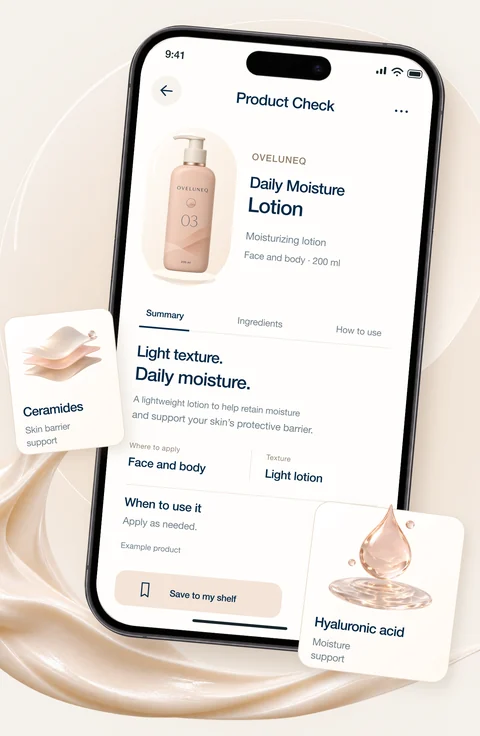
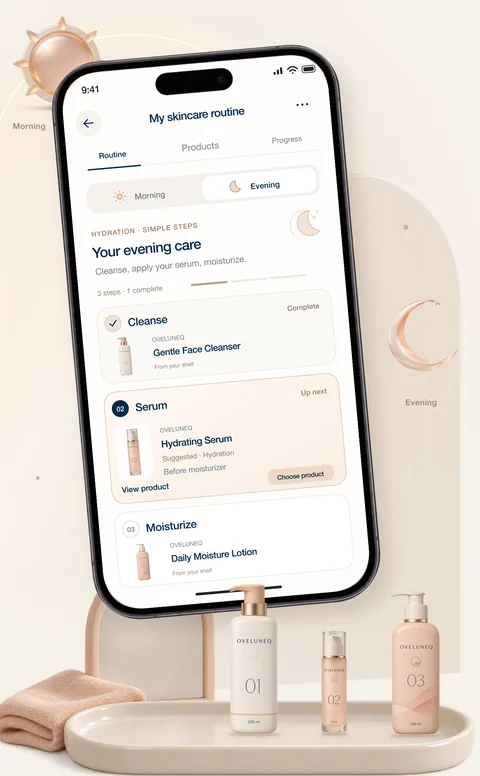
A typical morning routine is cleanser, an optional serum such as vitamin C, moisturizer and sunscreen. In DermaScanAI, Care Routine lays out these morning and evening steps in order with a reason for each one, and Skin Check includes sun protection in its care tips.
In the app
Try it in DermaScanAI: make sunscreen a daily step in your routine
Care Routine builds a morning and evening plan from your products, with the steps in order and a reason for each one, so sunscreen always lands at the end of your morning routine.
Product Check reads a photo of your sunscreen and lists its ingredients, what they're used for and how to use the product, with sources. In Skin Check, you choose your skin type and phototype yourself, and the cosmetic overview includes care tips such as sun protection.
- Check your sunscreen with Product Check
- Save it to your Shelf
- Build your Care Routine with sunscreen as the last morning step
- Ask the AI assistant about textures or reapplying over make-up
Questions
Frequently asked questions
What SPF should I use on my face every day?
For everyday use, choose a broad-spectrum sunscreen with SPF 30 or higher that also shows UVA protection on the label. Apply a generous amount as the last step of your morning routine. On long days outdoors, at the beach or in the snow, SPF 50 is a sensible choice.
Should I use SPF 30 or 50?
Both work well for daily use if you apply enough. SPF 50 gives a little more UVB protection than SPF 30, which helps on long days outside or if you tend to apply thinly. Neither blocks all UV, so applying the full amount and reapplying matters more than the number.
How much sunscreen should I put on my face?
Use about two finger-lengths of sunscreen, squeezed along your index and middle fingers, for your face and neck. That's close to the amount used to test the SPF. Spread it evenly and include your ears, hairline and the sides of your nose.
How often do I need to reapply sunscreen?
Reapply at least every two hours when you're outdoors, and right after swimming, sweating or towel drying. On an indoor day, a generous morning layer and a top-up before going outside is usually enough. Follow the water-resistance time on the label if you're swimming.
Do I need sunscreen on a cloudy day?
Yes. Much of the sun's UV passes through clouds, and UVA stays fairly steady all year. Wearing sunscreen every morning, whatever the weather, is the simplest way to keep protection consistent. Snow and water also reflect UV onto your face.
Does sunscreen go before or after moisturizer?
After. Apply moisturizer first, let it settle for a minute, then apply sunscreen as the last skincare step and before make-up. If your sunscreen is already moisturizing enough for your skin, you can skip a separate moisturizer in the morning.