Quick answer
- Ingredients are listed from highest to lowest concentration, so the first five usually make up most of the formula.
- Below about 1%, ingredients can be listed in any order; a preservative like phenoxyethanol often hints at where that line sits.
- Look for fragrance, listed as parfum or fragrance, plus named fragrance components such as linalool or limonene.
- Front-label claims like non-comedogenic or hypoallergenic are brand claims; the ingredient list shows what's actually inside.
- Compare like with like: two products that do the same job, side by side, starting with their first five ingredients.
Skincare ingredient list order: are ingredients listed by concentration?
Yes. In both the US and the EU, cosmetic ingredients have to be listed in descending order of predominance, which simply means the ingredient there's most of comes first. That's why water (aqua) so often opens the list: most creams, lotions and serums are largely water.
The first five or so ingredients usually make up the bulk of the formula, so they tell you the most about what you're putting on your skin. Is it a water-based gel, an oil-rich balm or a silicone-heavy primer? Ingredients further down are used in smaller amounts, but small doesn't mean unimportant: many cosmetic actives and preservatives do their job at low levels.
Then there's the 1% line. Ingredients present at 1% or less can be listed in any order after those above 1%, and colorants can come at the very end. The label doesn't mark where that line is, but you can often make a good guess.
- Phenoxyethanol, a common preservative, is capped at 1% in the EU, so anything listed after it is at 1% or less
- Fragrance (parfum) and thickeners such as xanthan gum usually sit in the lower part of the list
- In the EU, colorants appear as CI numbers, for example CI 77891, and are often grouped at the end
- If an ingredient advertised on the front comes after the preservative, it's at 1% or less, which can still be a typical level for some ingredients
Why do ingredient names look like chemistry? INCI names explained
Most labels use INCI names, short for International Nomenclature of Cosmetic Ingredients. It's a shared naming system, so the same ingredient carries the same name on a cream bought in Paris or in Chicago. The trade-off is that the names can look intimidating.
A long name is just a precise name. Sodium hyaluronate is a form of hyaluronic acid, tocopherol is vitamin E, and butyrospermum parkii butter is shea butter. Plant ingredients usually go by their Latin botanical name, and on US labels you'll often see a common name with another name in parentheses, as in water (aqua).
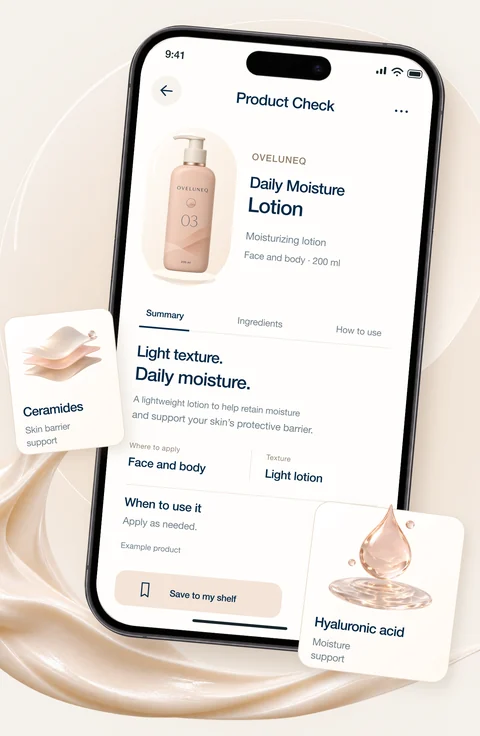
To look a name up, the European Commission's CosIng database lists cosmetic ingredients with their INCI names and functions; being listed there isn't an approval of the ingredient. Or skip the typing: photograph the product with Product Check in DermaScanAI to see its ingredients and what they're used for, with sources.
- Aqua: water
- Glycerin: a humectant that helps skin hold on to water
- Tocopherol: vitamin E, often used as an antioxidant in the formula
- Sodium hyaluronate: a form of hyaluronic acid used for hydration
- Butyrospermum parkii butter: shea butter
- Parfum: fragrance, a blend that can contain many components
Skincare ingredients and what they do: the main groups
Most ingredients on a list fall into a handful of jobs. Once you can sort them into groups, a long list becomes much easier to scan: you can see what gives the product its texture, what keeps it stable and which ingredients are there for a cosmetic effect on how your skin looks and feels.
- Humectants draw in and hold water: glycerin, hyaluronic acid, sodium hyaluronate, butylene glycol, panthenol
- Emollients soften and smooth the skin's surface: squalane, caprylic/capric triglyceride, shea butter, plant oils
- Occlusives form a light layer that slows water loss: petrolatum, dimethicone, beeswax, lanolin
- Surfactants do the cleaning in face washes: cocamidopropyl betaine, coco-glucoside, sodium laureth sulfate
- Emulsifiers and thickeners hold oil and water together and set the texture: cetearyl alcohol, carbomer, xanthan gum
- Preservatives keep water-based products from spoiling once opened: phenoxyethanol, ethylhexylglycerin, sodium benzoate
- Fragrance adds scent: parfum or fragrance, essential oils and named components like linalool or limonene
- Cosmetic actives target the look and feel of skin: niacinamide, ascorbic acid (vitamin C), retinol, and exfoliating acids such as glycolic or lactic acid
What does non-comedogenic mean? Label terms decoded
Front-of-pack words are claims made by the brand. Some are useful hints, but none of them replaces reading the ingredient list, and several have no official definition at all. Here's what the most common ones mean, and what they don't promise.
- Non-comedogenic: the brand says the formula is made not to clog pores. It's a useful hint when you're choosing products for blemish-prone skin, but there's no single official test behind it, so it can't promise how a product will suit you
- Fragrance-free vs unscented: fragrance-free means no fragrance has been added for scent, while unscented means the product has no noticeable smell, which can involve a masking fragrance. Check the list for parfum or essential oils either way
- Hypoallergenic: in the US there is no federal standard or definition for the term, so it means whatever the company says it means
- Dermatologically tested: a dermatologist was involved in some kind of testing, but the label rarely says how many people took part or what the results were
- Alcohol-free: usually means no ethyl alcohol (alcohol denat.); fatty alcohols such as cetyl alcohol can still be in the formula
- Clean and natural: these have no official definition for cosmetics, so they say more about marketing than about what's in the bottle
How do I compare two products by their ingredient lists?
An ingredient list comparison works best when the products do the same job: two vitamin C serums, two gel moisturizers, two cleansers. Comparing a cleanser with a night cream tells you very little, because they're built differently on purpose.
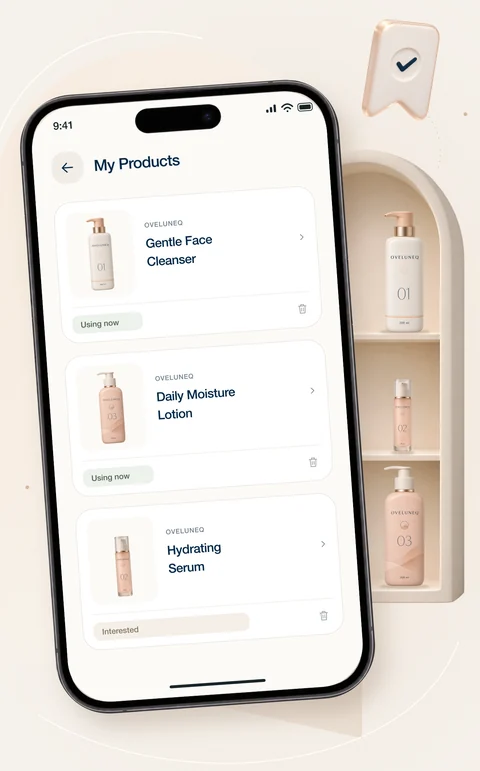
Doing this on your phone is easier when both products are in one place. In DermaScanAI you can check each product with Product Check and save it to your Shelf, so you can come back to each product's details while you decide.
- Put the two lists side by side, ideally as photos so nothing gets mistyped
- Compare the first five ingredients: they show the base, whether that's water, oils, silicones or alcohol
- Find each product's likely 1% line and see which side of it the advertised ingredient falls on
- Check for fragrance, essential oils and any ingredient you already know you'd rather avoid
- Look at the rest of the label too: texture, directions for use, pack size and price
Pregnant, or know some ingredients don't agree with you?
An ingredient list can't tell you whether a product is right for you personally. If you're pregnant, trying to conceive or breastfeeding, or you already know certain ingredients don't agree with your skin, take the full ingredient list, or the product itself, to your pharmacist or doctor and check with them before using it. The list makes that conversation easier, but it doesn't replace it.
Common mistakes when reading skincare ingredient labels
Reading ingredient lists is a skill, and a few habits can lead you to the wrong conclusion. These are the ones worth unlearning first.
- Judging a product by one ingredient: the whole formula, the amount and how you use it matter more than a single name
- Fearing every long name: chemical-sounding names are often familiar things like vitamin E or shea butter
- Trusting 'clean' or 'natural' on the front over the list on the back
- Assuming a bigger percentage on the front automatically means a better product for you
- Reading a list from a website instead of the pack you bought: brands reformulate, and versions can differ by country
In the app
Try it in DermaScanAI: check what's in your skincare with Product Check
Reading a list by hand is useful, but squinting at tiny print in a shop isn't much fun. Product Check lets you photograph a product and see its ingredients, what they're used for and how to use the product, with sources you can open yourself.
It explains what's in the product; it doesn't decide whether the product is right for your skin. Save the products you want to keep track of to your Shelf and come back to them when you're comparing or building a routine.
- Open Product Check and photograph the product or its ingredient label
- Read its ingredients, what they're used for and how to use the product
- Open the sources to read more about any ingredient
- Save the product to your Shelf to compare it or add it to your routine
Questions
Frequently asked questions
Are skincare ingredients listed in order of concentration?
Yes, mostly. Ingredients are listed from the highest concentration to the lowest, so the first few make up most of the product. The exception is the low end: ingredients at 1% or less can be listed in any order after the rest, and colorants can be grouped at the end. So the order gives you a ranking, not exact percentages.
What does the 1% rule mean on an ingredient list?
Once ingredients drop to 1% or less, brands don't have to keep them in strict order. The label doesn't show where that point is, but a preservative such as phenoxyethanol, which is capped at 1% in the EU, is a handy marker: anything listed after it is present at 1% or less. Plenty of ingredients still do their job at those levels.
What does non-comedogenic mean on a label?
It's the brand's claim that the product is formulated not to clog pores. It can be a helpful starting point if your skin tends toward clogged-looking pores or blemishes, but there's no single official test behind the term, and it can't guarantee how a product will suit you. Read the whole ingredient list and introduce new products one at a time.
What is the difference between fragrance-free and unscented?
Fragrance-free means no fragrance has been added for scent. Unscented means the product has no noticeable smell, which can be achieved by adding a masking fragrance to cover the smell of other ingredients. If you prefer to skip fragrance, check the list for parfum, fragrance, essential oils and named components such as linalool or limonene, whatever the front label says.
How do I read a skincare ingredient list quickly?
Start with the first five ingredients to see the base, then find the likely 1% line, for example a preservative such as phenoxyethanol, and check where the headline ingredient sits. Finally, look for fragrance and anything you'd rather avoid. To compare two products, do the same for both and keep them side by side.
Is there an app that tells you what's in your skincare?
Yes. Ingredient checker apps read the list from a photo of the packaging and explain it in plain language. In DermaScanAI, Product Check shows the ingredients, what they're used for, how to use the product and sources you can open. It explains the label; it doesn't decide whether a product suits you. If you're pregnant or know certain ingredients don't agree with you, check with your doctor or pharmacist.