Quick answer
- Oily: your whole face looks shiny within an hour or so of washing, and pores tend to look more visible.
- Dry: your skin feels tight after washing and can look dull or flaky, with very little shine.
- Combination: your forehead, nose and chin (the T-zone) get shiny while your cheeks feel normal or dry.
- Normal: your skin feels comfortable and balanced, with little shine or tightness.
- Sensitive-feeling: a trait that can go with any type, when many products sting or feel uncomfortable.
- Quickest check: cleanse, apply nothing, wait 30 minutes, then look at your skin in daylight.
How to check your skin type at home (the bare-face test)
The bare-face test is the easiest way to work out your skin type, and you don't need anything you don't already own. The idea is simple: take everything off your skin, give it time to settle back to its natural state, then see how much shine comes back and how your skin feels.
Do it on an ordinary day, ideally when you haven't just worked out and haven't tried a new product. Half an hour is usually enough, though you can wait up to an hour if you want a clearer picture of how quickly shine returns.
- Wash your face with a gentle, fragrance-free cleanser and lukewarm water
- Pat dry with a clean, soft towel instead of rubbing
- Apply nothing at all: no toner, serum, moisturizer or sunscreen
- Wait about 30 minutes and try not to touch your face
- Look in a mirror by a window in daylight and notice where you see shine
- Smile and raise your eyebrows: does your skin feel tight, comfortable or slick?
The blotting paper test: is my skin oily, dry or combination?
If the mirror doesn't give you a clear answer, blotting paper or a clean, thin tissue makes oil much easier to see. Do this at the end of the bare-face test, while your skin is still product-free.
Gently press a separate sheet on your forehead, nose, each cheek and your chin for a few seconds. Hold each one up to the light and compare how much oil it picked up from each area.
- Oil marks on every sheet: your skin is likely on the oily side
- Little or no oil anywhere, plus a tight feel: your skin is likely dry
- Oil from your forehead, nose and chin but not your cheeks: likely combination
- A little oil here and there, and skin feels comfortable: likely normal
What does each skin type look and feel like?
The tests give you a snapshot, but your everyday experience counts too. Think about how your face looks by lunchtime, how it feels after washing and how make-up or sunscreen wears through the day. Most people recognize themselves in one of these descriptions.
- Oily skin: shine comes back quickly, pores tend to look more visible, and make-up can slide or look patchy by midday
- Dry skin: feels tight after washing, can look dull or flaky in places, and foundation may cling to dry patches
- Combination skin: a shiny T-zone with comfortable or dry cheeks, so different areas may like different textures
- Normal skin: even and comfortable, with little shine or tightness, and most textures feel fine
- Sensitive-feeling skin: can sit on top of any type and shows up as stinging or discomfort with certain products
My T-zone is oily but my cheeks are dry: is that combination skin?
The T-zone is your forehead plus the line down your nose to your chin. This area tends to produce more oil than your cheeks, so a bit of shine there is common for almost everyone.
The difference comes down to your cheeks. If your cheeks also look shiny and feel slick an hour after washing, your skin is probably oily. If the shine stays in the T-zone and your cheeks feel normal, or even a little tight, you most likely have combination skin. Combination skin often does well with a lightweight moisturizer all over and a richer cream only where it feels dry.
Get a morning and night routine for oily skinIs my skin dry or dehydrated?
These two get mixed up a lot. Dry describes a skin type that tends to make little oil, so it often feels tight, looks dull and can flake, especially around the nose and on the cheeks.
Dehydrated-feeling skin is more of a temporary state that any type can have, oily skin included. Your face might look shiny yet still feel tight or rough, often after harsh cleansing, long hot showers, air conditioning or cold, dry weather. If that sounds familiar, a gentler cleanser and a moisturizer with humectants such as glycerin or hyaluronic acid are common choices, and you may not need a heavy cream at all.
- Tight, flaky and rarely shiny: likely dry skin
- Shiny in places but still tight or rough: likely dehydrated-feeling skin
What is my skin type if I sweat a lot or live somewhere humid?
Sweat and oil are easy to confuse. Sweat is watery and dries off, while oil feels slick and leaves a greasy, see-through mark on blotting paper. If you live somewhere hot and humid, or you've just been active, do the bare-face test indoors in a cool room so sweat doesn't make your skin look oilier than it is.
Climate and seasons also change how skin behaves. Many people feel oilier in summer or the rainy season and drier in winter or in heated and air-conditioned rooms. That doesn't mean your type has completely changed, but it's a good reason to repeat the test every few months and switch textures when the weather shifts.
How to tell if your skin is sensitive (a trait, not a type)
Sensitive-feeling skin describes how your skin reacts to products and surroundings rather than how much oil it makes, so you can have oily skin that feels sensitive or dry skin that feels sensitive. You might notice it when products sting, tingle or feel uncomfortable, or when your skin seems to dislike fragrance, strong exfoliants or frequent product changes.
The practical answer is to keep things simple: fewer products, fragrance-free options and one new product at a time. Patch-test anything new on a small area, such as along your jawline, for a few days before using it on your whole face. If a product keeps bothering your skin, stop using it and ask a pharmacist or doctor for advice.
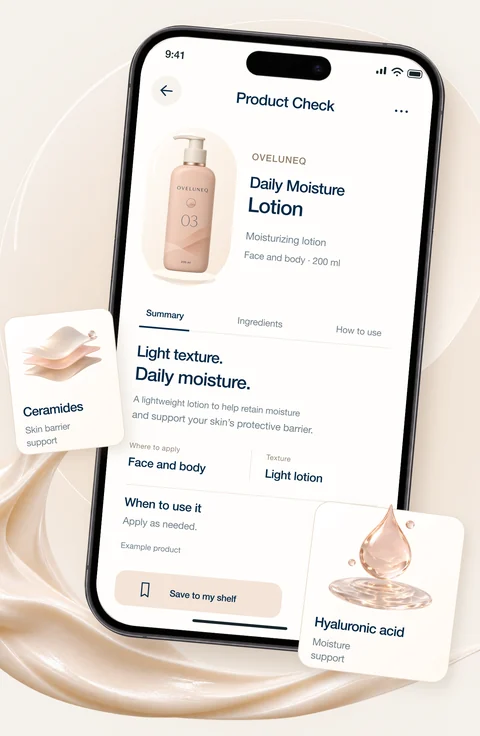
Reading the ingredient list first helps too. In DermaScanAI, Product Check lets you take a photo of a product and see its ingredients, what each one is used for and how to use it, so ingredients like fragrance or exfoliating acids are easier to notice before you buy.
Which skincare routine fits my skin type?
Every skin type uses the same basic order: cleanse, moisturize and, in the morning, apply sunscreen. What changes is the texture and how much you use. Stick with these three steps for a few weeks before adding serums or other extras, so you can see how your skin gets on with each product.
Daily sunscreen belongs in every routine, whatever your type. How easily your skin tends to burn or tan can help you decide how often to reapply and when to add shade, a hat or sunglasses.
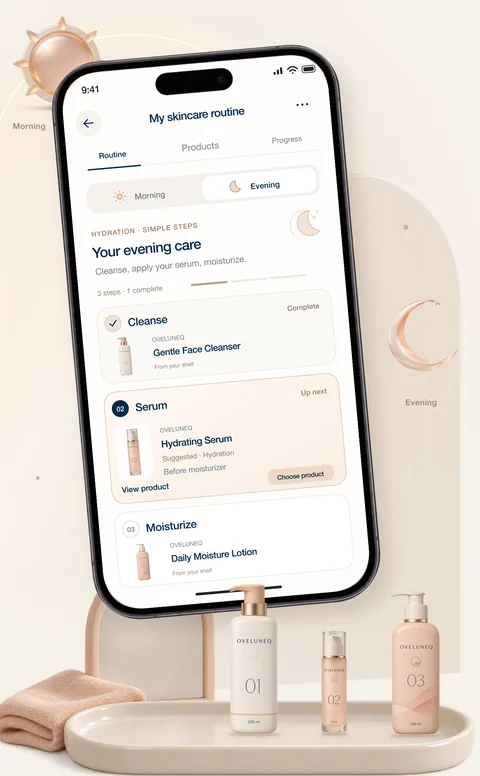
Once you know your type, Care Routine in DermaScanAI can turn the products you already own into a morning and evening plan, with the order of each step and a short reason for it.
- Oily: gel or foaming cleanser, lightweight gel or lotion moisturizer, oil-free fluid sunscreen
- Dry: cream or milky cleanser, richer cream moisturizer, moisturizing sunscreen
- Combination: gentle gel cleanser, light lotion all over with extra cream on dry areas, lightweight sunscreen
- Normal: gentle cleanser, lotion or light cream, any sunscreen texture you enjoy wearing
- Sensitive-feeling: fragrance-free cleanser, simple moisturizer, a sunscreen you've patch-tested first
In the app
Try it in DermaScanAI: pick your skin type in Skin Check
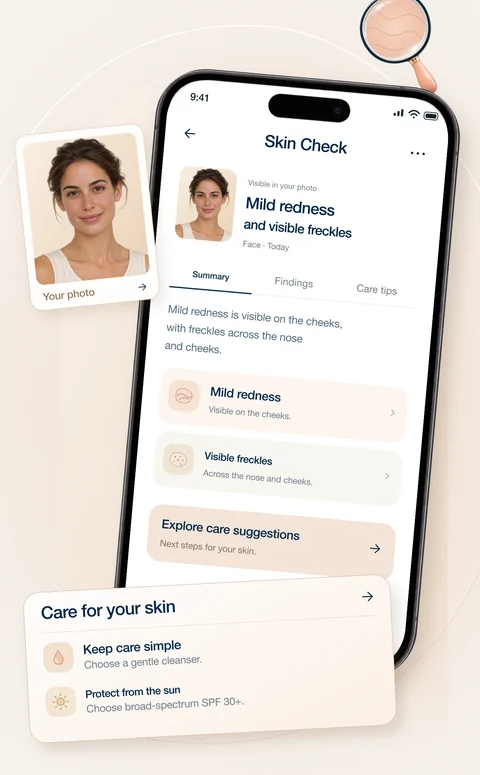
Once you've done the bare-face test, open Skin Check. You choose your skin type yourself, along with the area you're photographing and how easily your skin tends to burn or tan, then take a photo to get a cosmetic overview of how your skin looks, with care tips. The app doesn't decide your skin type for you; your own at-home test does that.
From there you can build a Care Routine around your type and ask the AI assistant follow-up questions about textures or product order.
- Open Skin Check and select the area, your skin type and your phototype
- Take a well-lit photo in daylight, without filters
- Read your cosmetic overview and care tips
- Build a morning and evening Care Routine for your type
Questions
Frequently asked questions
How do I know if my skin is oily, dry or combination?
Wash with a gentle cleanser, apply nothing and wait about 30 minutes. If your whole face looks shiny, your skin is likely oily. If it feels tight or looks flaky with little shine, it's likely dry. If only your forehead, nose and chin are shiny while your cheeks feel normal or dry, that points to combination skin. Comfortable, balanced skin with little shine is usually normal.
How can I test my skin type at home?
Use the bare-face test: cleanse, pat dry, skip every product and check your skin in daylight after about 30 minutes. For a closer look, press blotting paper or a thin tissue on your forehead, nose, cheeks and chin and compare the oil on each sheet. It takes around half an hour and needs nothing you don't already have at home.
Is my skin oily or just dehydrated?
If your skin looks shiny but still feels tight, rough or uncomfortable after washing, it may be oily skin that feels dehydrated rather than truly dry. This often happens after harsh cleansers, long hot showers or time in air-conditioned rooms. A gentler cleanser and a lightweight moisturizer with humectants like glycerin are common choices. Truly oily skin tends to feel slick and comfortable rather than tight.
My skin is oily in summer and dry in winter: has my skin type changed?
Probably not. Your general tendency often stays similar, but how your skin looks and feels shifts with the weather, humidity, heating, air conditioning and the products you use. Many people feel oilier in hot, humid months and drier in winter. Repeat the bare-face test every few months and switch to lighter or richer textures to match.
What is the difference between skin type and skin tone?
Skin type describes how your skin behaves: how much oil it makes and how it feels, such as oily, dry, combination or normal. Skin tone describes its color, from lighter to deeper, and is what most people think about when choosing a foundation shade. The two are independent, so any skin tone can be any skin type, and your product textures mostly follow your type.
Can an app tell me my skin type?
Be careful with any app or online quiz that promises to name your skin type from a single photo, because lighting, filters and recent products all change how skin looks on camera. The at-home bare-face test is a better starting point. In DermaScanAI you choose your skin type yourself in Skin Check; the app then gives a cosmetic overview of how your skin looks and helps you build a routine.