Quick answer
- Ceramides are skin-identical lipids that help support the skin's moisture barrier.
- A ceramide moisturizer helps skin feel softer, smoother and more comfortable.
- They suit all skin types: choose a gel-cream for oily skin and a richer cream for dry skin.
- Look for ceramide NP, AP or EOP on the label, often with cholesterol and fatty acids.
- Ceramides pair well with retinol, acids, hyaluronic acid and niacinamide.
- Use them morning and night as part of your moisturizer step.
What are ceramides, and what do they do for my face?
Ceramides are a family of lipids, or fats, found naturally in the outermost layer of your skin. Together with cholesterol and fatty acids, they fill the spaces between skin cells, a bit like mortar between bricks. That structure is what people mean by the skin's moisture barrier: it helps keep water in and keeps your skin feeling comfortable.
Skincare products add ceramides to help support that barrier from the outside. In cosmetic terms, a moisturizer with ceramides helps skin feel softer and smoother, less tight after washing and more comfortable in dry air. It's a gentle, supportive ingredient rather than an active that changes how your skin looks overnight.
- Support the skin's moisture barrier
- Help skin hold on to moisture and feel less tight
- Leave skin feeling softer and smoother
- Work well alongside stronger actives in a routine
My skin feels dry and tight: do I need a ceramide moisturizer?
A ceramide moisturizer is a sensible choice when your skin often feels tight after cleansing, looks a little flaky or feels uncomfortable in cold weather or heated rooms. Ceramides help support the barrier, while humectants such as glycerin or hyaluronic acid draw water into the skin, and the two work well together.
Habits matter just as much as the product. Hot water, harsh cleansers and too much exfoliation all leave skin feeling drier, so the moisturizer has to work harder. If your skin stays uncomfortable despite a gentle routine, ask a pharmacist or doctor.
- Wash with lukewarm water and a gentle, non-foaming cleanser
- Apply moisturizer within a few minutes of washing, on slightly damp skin
- Use it morning and night, with sunscreen on top in the morning
- Cut back on exfoliating products while your skin feels tight
Is a ceramide moisturizer good for my oily or combination skin?
Yes. Ceramides aren't greasy in themselves; the feel of a product comes from the rest of the formula. Oily skin still needs a moisturizer, and a supported barrier often feels more balanced. What changes between skin types is the texture you choose.
- Oily skin: a lightweight gel-cream or fluid lotion
- Combination skin: a light lotion all over, with a little extra on dry areas
- Dry skin: a richer cream, especially at night or in winter
- Sensitive-feeling skin: a short, fragrance-free formula
How do I find ceramides on an ingredient list?
Ceramides go by several INCI names. The most common ones are ceramide NP, ceramide AP, ceramide EOP, ceramide NS and ceramide EOS. You may also see older names such as ceramide 1, 3 or 6 II, or phytosphingosine and sphingolipids, which are related ingredients.
Look at what sits next to them, too. Ceramides are often combined with cholesterol and fatty acids, mirroring the mix found in skin. Because they're used in small amounts, they often appear in the second half of the list, which is normal.
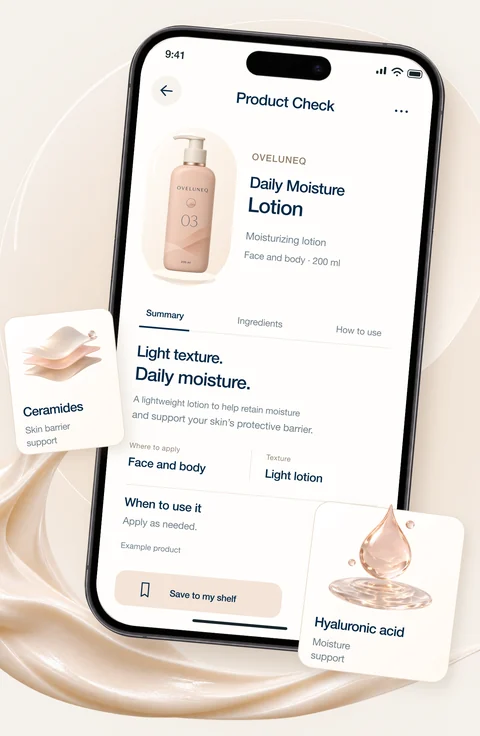
If you'd rather not decode the label yourself, take a photo of the product with Product Check in DermaScanAI. It lists the ingredients, what they're used for and how to use the product, with sources, and you can save it to your Shelf.
- Ceramide NP, AP, EOP, NS or EOS
- Cholesterol
- Fatty acids such as linoleic or stearic acid
- Phytosphingosine
Can I use ceramides with retinol, hyaluronic acid or niacinamide?
Ceramides are one of the easiest ingredients to combine. They're often recommended alongside stronger steps precisely because they help skin feel more comfortable while it gets used to them.
- Ceramides + retinol: a common pairing; apply moisturizer after retinol, or before and after it on dry nights
- Ceramides + glycolic or salicylic acid: a ceramide moisturizer helps skin feel comfortable after exfoliating
- Ceramides + hyaluronic acid: apply hyaluronic acid to damp skin first, then the ceramide moisturizer
- Ceramides + niacinamide: an easy pairing, and many moisturizers already contain both
- Ceramides + sunscreen: moisturizer first, sunscreen last in the morning
Ceramides vs peptides: what's the difference?
They do different jobs, so it isn't a case of choosing one. Ceramides are lipids that help support the moisture barrier and keep skin feeling comfortable. Peptides are short chains of amino acids used in skincare to help skin look smoother and firmer.
Many moisturizers contain both. If comfort and dryness are your main concern, ceramides are the more relevant ingredient. If you're mainly interested in the look of fine lines, a peptide serum under a ceramide moisturizer is a straightforward combination.
In the app
Try it in DermaScanAI: see if your moisturizer contains ceramides
Product Check reads a photo of your moisturizer and lists its ingredients, what they're used for and how to use the product, with sources. It shows at a glance whether ceramides, cholesterol or humectants are in the formula.
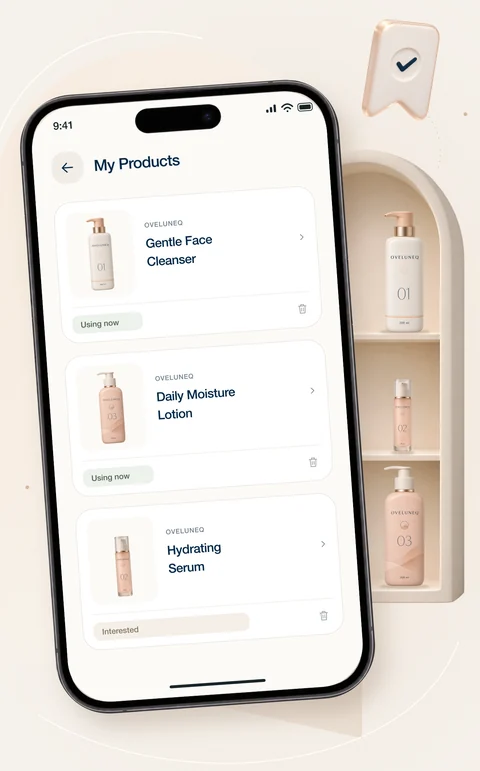
Save the products you use to your Shelf, then build a Care Routine with morning and evening steps in order and a reason for each step.
- Open Product Check and photograph your moisturizer
- See its ingredients and what each one is used for
- Save it to your Shelf
- Add it to your morning and evening Care Routine
Questions
Frequently asked questions
What do ceramides do for my face?
Ceramides are lipids that occur naturally in your skin and help hold its outer layer together. In a moisturizer, they help support the moisture barrier, so your face feels softer, smoother and less tight. They're gentle and suit all skin types.
Is a ceramide moisturizer good for my oily skin?
Yes. Ceramides themselves aren't heavy or greasy; the texture depends on the rest of the formula. Oily skin still benefits from a moisturizer, so choose a lightweight gel-cream or fluid lotion with ceramides and see how your skin feels after a couple of weeks.
Can I use ceramides with retinol?
Yes, and many people do. Apply retinol to clean, dry skin at night, then a ceramide moisturizer. On drier nights, try a thin layer of moisturizer before and after retinol. If you're pregnant or breastfeeding, check with your doctor or pharmacist before using retinol.
Can I use ceramides and hyaluronic acid together?
Yes, they're a natural pairing. Hyaluronic acid draws water into the skin, while ceramides help keep it there. Apply a hyaluronic acid serum to slightly damp skin, then seal it in with a ceramide moisturizer.
How do I find ceramides on an ingredient list?
Look for names that start with ceramide, such as ceramide NP, AP or EOP, as well as phytosphingosine. They're often listed near cholesterol and fatty acids. Because they're used in small amounts, they usually appear in the second half of the list.
Should I use a ceramide moisturizer morning and night?
You can. Ceramides are gentle enough for twice-daily use. In the morning, apply your moisturizer before sunscreen; at night, use it as your last step or after any serum or retinol. Some people choose a lighter texture for the day and a richer one at night.